
Once more, life and lack of energy have sidetracked me from documenting this theatre outing sooner after the event. In a way, it’s been a good thing, because I wanted to reflect on the experience and find words to do it proper justice. On the other, it feels a little redundant to write now, since the show ended its run on Saturday. All the same, I wanted to write on this one as it was only my second time at the Almeida, and a really special experience.
The Hunt, known in Danish as Jagten was originally a 2012 film collaboration between director Thomas Vinterburg and screenwriter Tobias Lindholm. In this, its world premiere for the stage, it was adapted by David Farr and directed by Rupert Goold. Tobias is known for penning gritty moral dramas, and having now seen the play, I can’t think of a more apt description!
We are a small community. The happiness of our children is everything – our hopes and dreams rest in these tiny souls.
In a small town in northern Denmark, Lucas has been making a fresh start after separating from his wife. He teaches at the school, where he has made a wonderful impact with his young students, and in turn has been welcomed into the fold by the men of the hunting lodge. A young girl named Clara, a pupil of Lucas’ sets off a chain of events that threatens to tear the community apart as she accuses Lucas of sexually abusing her. Suspicion is rife, and friendship are tested to breaking point as Lucas fights to clear his name.
For some, I read the subject matter was too dark and disrespectful, given the climate we live in (#MeToo and so on), but for me the essence of great theatre encompasses everything: it challenges, provokes, makes us question and think, a quality that The Hunt had in spades.
Despite the unsettling subject matter then, I can say with complete conviction that I was hard pressed to think of another example of a play that affected me in quite the same way and as deeply as this one did, in all the best ways possible. I can vividly remember repeatedly being aware of the fact I was holding my breath because I was so scared of breaking the spell it had created…
A spell woven expertly by the creative team: especially in terms of the set and lighting. The set, designed by Es Devlin, consisted of a small raised revolve upon which a small house sits, exactly like the one a child might draw, and this space morphs into a variety of spaces – church, school office, hunting lodge/grounds and so forth. It enabled any number of the cast to fit in it at any one time – thus reinforcing the sense of community, but more strikingly the palpable sense of claustrophobia. Neil Austin’s lighting, by turns raw, vivid white and icy blue, and Adam Cork’s soundscape are both as haunting as they are hypnotic. Everything feels sharper and heightened in the Almeida as it’s such an intimate space, I was on edge the entire time (and cursing my ridiculous startle reflex as I was probably a little bit too jumpy!), but the whole effect is intoxicating and I couldn’t take my eyes off it.
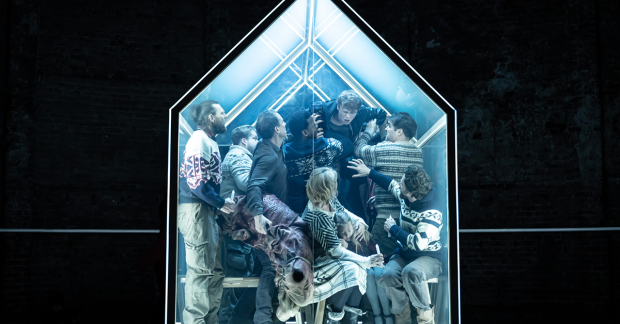
Credit: Marc Brenner
Farr’s adaptation plays an interesting game of twisting one’s expectations about the dynamics. Because of the impact of Clara’s testimony, the adults are the ones that start seeing the world as clear cut: good and evil, black and white; and it’s the children who question, who empathise, who see the complexities. This excited me so much as it gave another layer to the piece: it’s a play about what happens when civilisation becomes feral, rituals and masculinity, and hypocrisy. Goold’s direction works wonderfully in tandem because of how nuanced it is: I got the sense that every word and moment was there for a reason, nothing unnecessarily wasted.
I can’t recall the last piece of theatre I saw where I was so impressed by the calibre of the child actors, so I wanted to give them a line or two to begin with! At my performance, George Nearn Stuart played Peter, all boundless energy and captivating smile, and Abbiegail Mills, in her professional stage debut played Clara. Caught between two warring parents, Clara becomes quiet, reserved and immensely superstitious. Though she doesn’t speak much, what she does say holds weight far beyond simply moving the plot forward: it’s incredibly emotional and the sense of innocence she gives it is astounding. To watch the two of them hold their own in such tense, deep and at times very uncomfortable subject matter was really impressive.
Michelle Austin, playing headmistress Hilde was beautifully nuanced. She begins the play all warmth and bluster, welcoming the audience to the school as a crowd of parents coming to watch the Harvest Festival. She has a good relationship with Lucas, and the two have some fun banter, and yet when he is accused, Hilde has a duty of care to the students to investigate and look after Clara. To watch her go through that arc and become so conflicted was really moving.
Poppy Miller and Justin Salinger play Clara’s parents, Mikala and Theo, both stunningly played as they move between blind fury and their own doubts. Poppy has a particular standout scene with Abbiegail in which they are making paper angels for Christmas decorations, and Mikala tries desperately to reach and connect with her daughter; it’s really moving as Clara is closed off, reclusive. Theo, on the other hand, is more visceral in his emotions: Justin has an incredible scene where he confronts Lucas, his oldest friend; anger, pain and confusion raw and palpable.
There’s strong work, too, from the male ensemble led by Danny Kirrane as Gunner, as the men chant their way through drinking songs, and decide what they’d do if there were none of the fairer sex left on earth They’re raucous and rowdy, contrasting them with Lucas, who’s more introverted makes the dynamics at play all the more interesting. Stuart Campbell also shines in the role of Lucas’s loving son Marcus, unwavering in his support and belief of his father when no-one else will fight his corner.
At the centre of it all though, is an absolutely extraordinary performance from Tobias Menzies as Lucas. Being a fan of his film and television work that I’ve seen, it meant so much to me to be able to watch him work in person. I think he has an incredible gift for nuance, things he doesn’t say are just as important as the words he speaks; his eyes are so expressive and he makes the smallest gestures speak volumes. Lucas is closed off and introverted, but in his scenes with Marcus and Clara are remarkable in terms of their warmth; it’s easy to see how Clara is drawn to him. He’s grave and gentle, even in the jaws of mass hysteria; and there’s a real sense of truth and devastatingly gritty realism to his performance that had me absolutely rapt from start to finish.
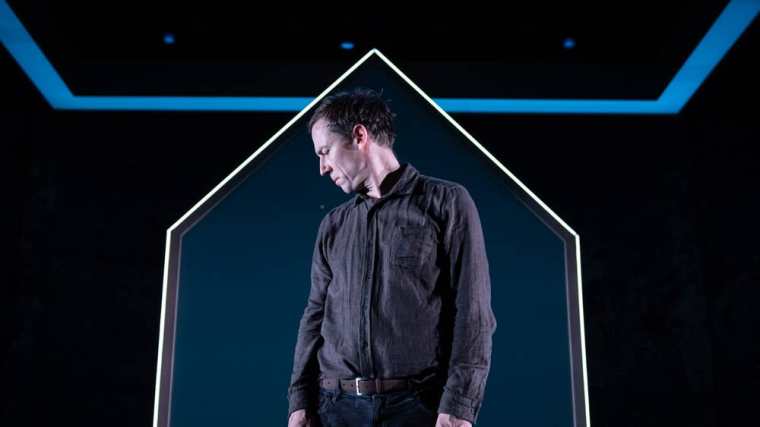
Credit: Marc Brenner
A little icing on the cake – waiting for my friend Rachel to arrive, I freaked out a little bit when Tobias stepped out for a few minutes feet from me. I didn’t want to bother him, so I ended up writing him a letter and enclosing my programme in the hopes of getting an autograph. A fortnight went by, and the show’s closing date loomed ever closer. Losing hope, in the end I just wanted to know if my letter reached him or not. I contacted the Almeida, and unfortunately my letter and programme couldn’t be found. The staff were kind enough to organise a new one, and Tobias agreed to sign it for me; I came home to it on the show’s closing night!
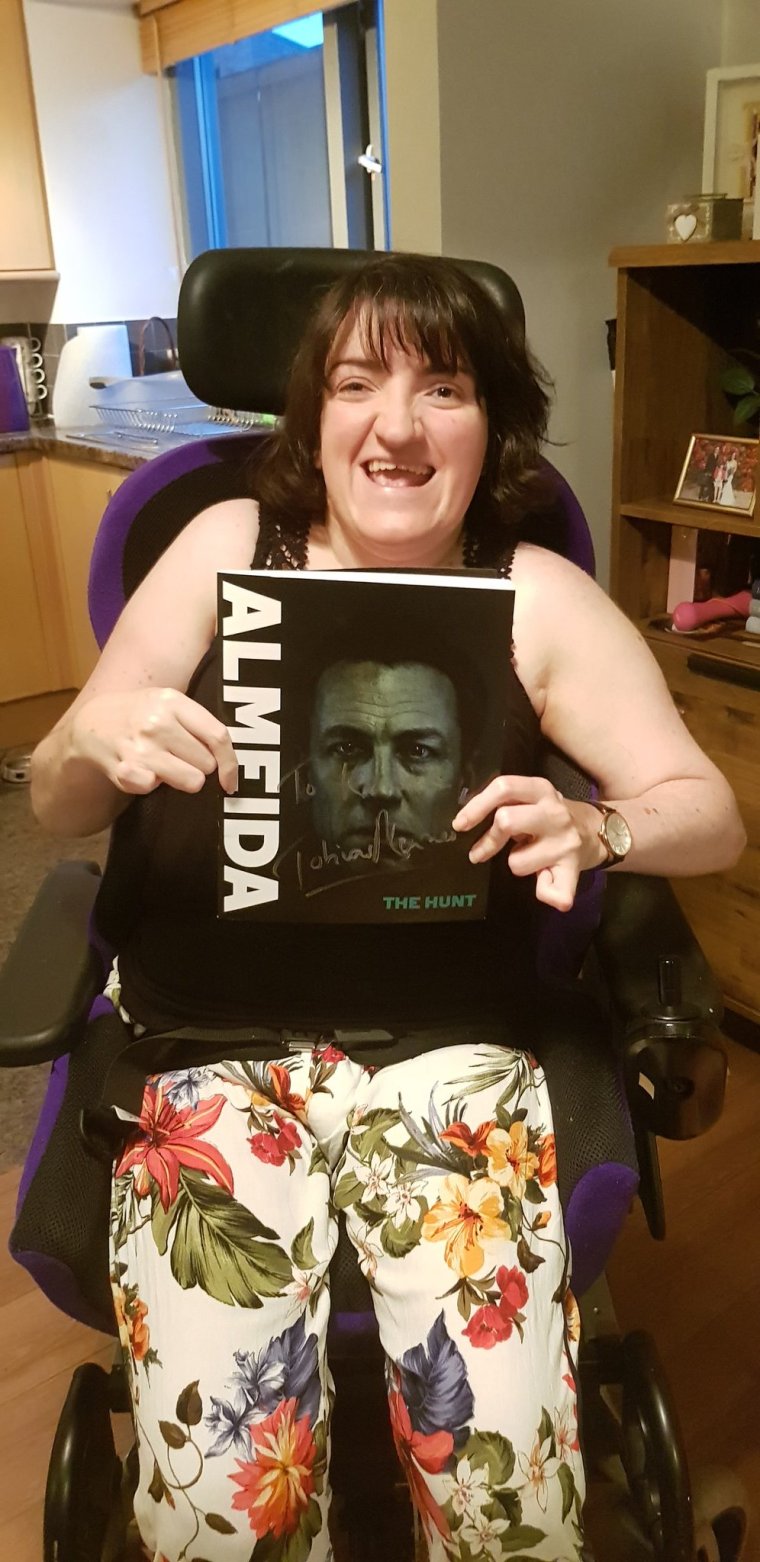
 Wheelie Stagey
So well written. 👍🏻👏🏻👏🏻👏🏻👏🏻
Sent from my iPad
>
Aw, thanks Linda – you’re always so kind & supportive of my writing and I hope you know it’s massively appreciated ☺ x