
Manchester seems to be the place where I’m slowly building up some amazing theatrical memories. I’ve seen my favourite leading man in a play inspired by a famous chess match, gone into the woods courtesy of my favourite composer and yesterday got to go back in time to the world of vaudeville and old school Hollywood glamour seeing Arthur Laurents, Jule Styne’s and Sondheim classic Gypsy for a second time, this time courtesy of the Manchester Royal Exchange.
When I saw the show in 2015 as a complete newbie outside of a song or two without their context, I was swept away by everything about it. I learned here however that a fresh take and style can take your expectations and love for the show to a totally different level: there’s a grit and edge to Jo Davies’ production that feels intoxicating; not least because of the Royal Exchange’s marvellous in the round setup. Being able to look the company straight in their eyes as they sing to you or make their entrances and exits next to you gives the whole thing a tremendous sense of intimacy which serves the story really well as it’s essentially about what happens when the curtains come down, and before they go up! The revolving stage and the proscenium arch come lighting gantry in Francis O’ Connor’s sleek design is also a clever touch. I particularly enjoyed Colin Grenfell’s lighting, atmospherically bright and haunting by turns.
One of my favourite choreographers, Andrew Wright, imbues the space with great energy and personality; everyone dances like a dream, especially Louis Gaunt in a charming turn as Tulsa! The costumes by Gabrielle Dalton sunk myself and my friend Christine into longing, dreamy fantasies, I especially adored Louise’s pink dress when she takes her first steps into transforming into Gypsy Rose Lee, and her glittering red final scene gown.
As always, it is a treat for me to be able to see the band onstage, and watch a conductor’s palpable joy in sharing the music.
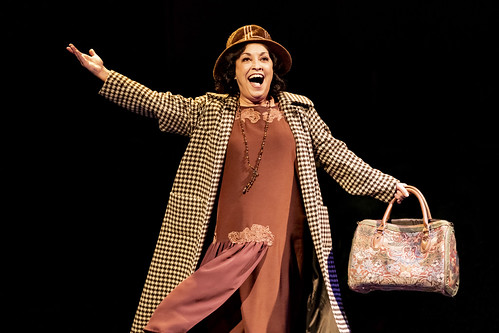
Stagecraft in such great shape as this then, needs an equally strong cast to elevate it, and I was tremendously pleased to find that here – I found myself able to focus and invest in many more of the characters this time around. At the heart of it, we have Ria Jones as the formidable Mama Rose. Like many of the performers I now know and adore, Ria was a late discovery for me: she came into my life back in 2018 when I saw Sunset Boulevard on tour at my local theatre. I was reviewing for BroadwayWorld on the night in question, and it was an absolute masterclass; earning one of a handful of five star reviews I’ve given out in my time there so far. The level of depth Ria gives to her characters is mesmerising and as I found here, made Rose an even more interesting character than I remember from those years back. There’s a warmth and softness to her that surprised me as it made Rose feel more natural and relatable, and in that sense I loved how that also helped me enjoy the less familiar numbers in the score more than I did the first time round: Some People and You’ll Never Get Away From Me in particular were highlights.
Let’s be real though, the showstoppers
were phenomenal, especially Rose’s Turn – I was parked in the second row looking directly onstage centrally, and there’s a point where Ria turns and sings “someone tell me when is it my turn, don’t I get a dream for myself?” She looked me square in my eyes as she sang this and the feeling that gave me was absolutely electric, it gave me a chill and felt, just for a moment, like I was the only person in that auditorium and Rose was baring her soul to me alone; it was magical! I tweeted her that night saying that if it weren’t for the fact of a three and a half hour journey home, I wanted so badly to wheel round to Stage Door and tell her, very inarticulately how blessed I felt having seen her play this role. I stand by those feelings with all my heart.
Credit: Johan Persson
In Ria & Davie’s hands, what I also enjoyed was the feeling that the emotional dynamics of scenes don’t always build towards a climax where you might expect them to. They shift around constantly, the gut punch might come instead in where a joke lands, or the way a line is given rather than what’s actually said, there’s a subtleness of touch to it that kept me listening intently even though I knew what was coming up.
Looking back on my first trip all that time ago, Peter Davison whilst sweet, didn’t leave the emotional impression I wondered if Herbie should as a character. Here, Dale Rapley, from the minute he stepped onstage held my heart, and broke it utterly when he left it for the final time. He made Herbie vulnerable and immensely endearing, and it was a joy to hear him sing a more “old school” musical theatre score, the harmonies were brilliant and his chemistry with Ria charming and likeable.I’ve seen Dale in three very different roles now and he always surprises me, it was a joy seeing him more centre stage this time.

Credit: Johan Persson
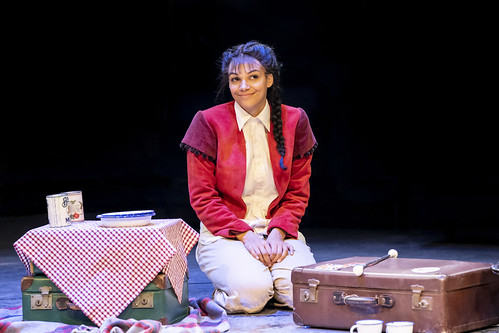
Melissa James took my breath away as Louise, the smallest moments and changes of expression were captivating: Little Lamb sent shivers up my spine and brought a tear to my eye! There’s a really interesting sense of physicality to her portrayal as well, as Louise blossoms in confidence her body language slowly changes and by the time we see her fully transformed into Gypsy Rose Lee, she radiates confidence and seems at peace with herself; as a young woman who sometimes feels as Louise does I took immense joy and pride from the way Melissa illustrated that journey with such sensitivity and grace.
Credit: Johan Persson
The final scene between mother and daughter really moved me, and I enjoyed the fact they kept a note of humour in its ending and left things on a potentially more uplifting note than I understand previous productions over the years have.
Melissa Lowe, Louise’s sister June, also shines and the two are brilliant together. There’s also scene stealing work from Suzie Chard, Katie O’ Donnell & Rebecca Thornhill who remind us why You’ve Gotta Get A Gimmick!
2015 introduced me to this show. 2019 showed me I actually properly loved every second of it.
 Wheelie Stagey