
“This book is not about heroes. English poetry is not yet fit to speak of them. Nor is it about deeds, or lands, nor anything about glory, honour, might, majesty, dominion, or power, except War. Above all I am not concerned with Poetry. My subject is War, and the pity of War. The Poetry is in the pity.”
So proclaims the preface of Wilfred Owen’s collected poems, three words of which are used to title Stephen MacDonald’s 1982 play. Marking the centenary of World War One, 2014 saw Blackeyed Theatre take their production of the play all around the UK, and for 24 hours made their archive recording of the piece available via Youtube.
A ways back, I stumbled across James Howard talking about his experience starring in the play, and doing a beautiful reading of a piece of Siegfried Sassoon’s work. This encouraged me to go away and explore more, and also refreshing my memory of fellow soldier and poet Wilfred Owen’s work, some of which I’d studied in secondary school. Therein was my foundation coming to this piece which I’m so grateful to have caught, because it’s exquisitely observed.
Not About Heroes chronicles the real life friendship between Sassoon and Owen, who meet as fellow patients at Craiglockhart War Hospital in 1917; with Owen recovering from shellshock and Sassoon from a bullet wound and diagnosed with “war neurosis” as a result of his vocal protest against the conflict. Through a series of flashbacks, diary entries and letters, Siegfried reflects on their deep bond, the tragic events that shaped their lives and ultimately changed the landscape of British war poetry forever.
I’ll confess: two hander plays like this often make me nervous as I’m constantly questioning “how can they make x subject matter engaging with just two people”, and so on. With only a vague recollection of some of Owen’s work through my studies and a love of learning about history that’s been significantly… dimmed in years gone by, I found those old prejudices rearing their heads again. This piece taught me I should work on those, because in the just shy of two hours it took for the piece to unfold, I was riveted; moved as much by the moments of warmth and wit (Sassoon despairing at a letter from HG Wells that he misreads is a particular favourite) as I was by the gritty realism encapsulated by Victoria Spearing haunting set design, the focal point of which are a series of ambiguous cut out figures that for me resembled people and later, barbed wire that loom at the back of the stage, complimented beautifully by Charlottle McClelland’s lighting design, and Tom Neill’s strikingly evocative score. Projection Design by Clive Elkington is also hugely atmospheric, and thus the play does some incredible work to show us, the audience, the horrors of war. It doesn’t shy away from that context, but director Eliot Giuralarocca strikes a balance between tones throughout that kept me invested.
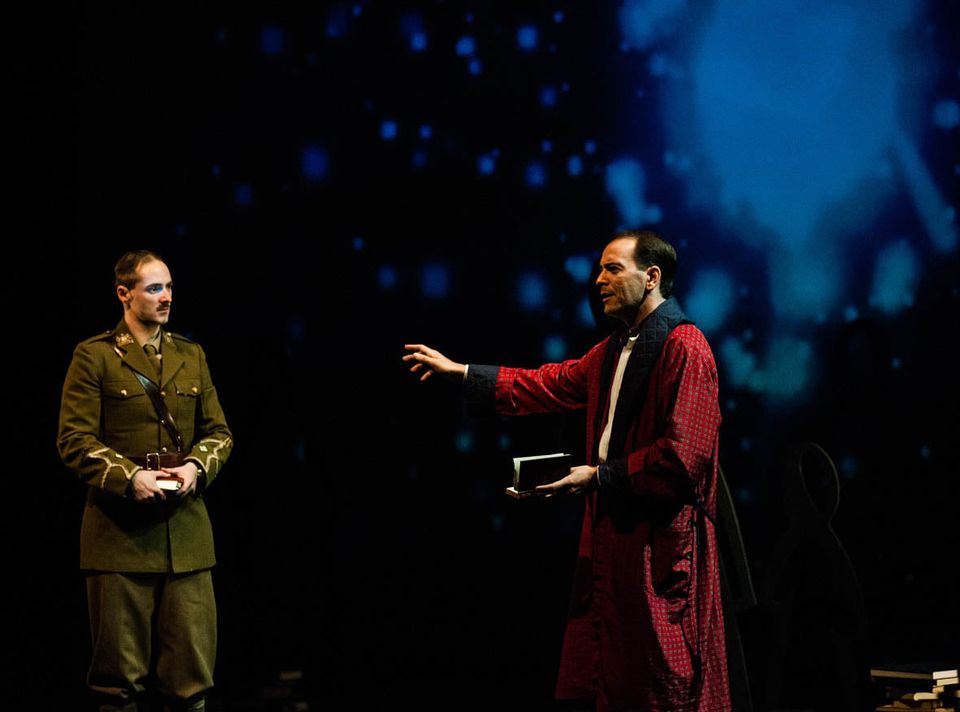
Yes, this is a piece about war, but more than that it is about friendship and how one’s life can be changed for the better by the connections we have, and there’s something I found tremendously intimate about that. For two actors alone to carry such weight in the portrayal of real people alongside such loaded and emotive subject matter is no mean feat, and the two gents here more than rise to the occasion.
When we first meet Ben Ashton’s timid, somewhat starstruck Wilfred Owen, he shyly sneaks into Sassoon’s room to beg autographs on the latter’s latest book of poems for his mother, various relatives and himself, and later asks him to help him with his writing, and thereby initially you have a rather endearing mentor and protege relationship. Over the course of the play, that dynamic shifts subtly yet incredibly powerfully as Wilfred becomes a celebrated poet in his own right, and makes the devastating decision that we’ve been forewarned about. To watch Ben play that arc is so satisfying as he does so with such ease and depth that you’re immediately charmed by him, and that quality is relentless.
It woulde be 3 years after this play that James Howard came into my life, as Draco Malfoy in Harry Potter & The Cursed Child. As those of you who know me already will realise then, I’m already in awe of and adore watching him. On the simplest note, just to have had the opportunity to see him play a different role is something I’ll always treasure. I’m consistently amazed by the charisma and presence he has, and I hang off his every word – a quality I got in spades again here and was so grateful for – this play can get incredibly “wordy” and I had to concentrate hard to ensure I was following the timeline and catching all the emotional beats but in the hands of these two immensely talented actors, that became a pleasure not the chore I’d been fearing it could have. I came away deeply touched and better enlightened about two important literary figures in our history, and thanks to a book recommendation from James, am looking forward to becoming further acquainted with them.
 Wheelie Stagey