
I know myself that I am not the most well versed or shall we say, proactive person when it comes to learning about historical events, people and so on. So, to work on that, one of my favourite ways to learn and educate myself is art in all its forms, especially theatre. In the programme for Giles Terera’s debut play The Meaning of Zong, there is a conversation between him and Bristol Old Vic’s Artistic Director, Tom Morris, where Terera stated:
“For me, it was about finding a way to tell this story so that the audience could listen to it, hear it, see it without fear.” That quote really struck a chord with me, even before the play had started because I think it encapsulates why plays can really resonate with me: there’s an intensity about the shared experience of live theatre that I feel can really drive home the themes and messages, especially with stories that are inspired by true events, and when you factor that in amongst all the other elements of stagecraft that come into play: set, lighting, music, costume and so on, the potential you have to create something powerful, and perhaps more importantly meaningful, is massive. The quote also stayed under my skin watching the play and has afterward, because The Meaning of Zong is bold, visceral and manages to frame a deeply troubling part of British history in a way that becomes incredibly evocative and moving.
In November 1781, 132 Africans aboard the slave ship Zong were massacred after a series of navigational errors and fears over dwindling drinking water supplies. As was common practise at the time, the William Gregson slave ship syndicate took out insurance against the enslaved people, deemed as cargo. Once they made land, the ship owners made a claim on their insurance to mitigate their losses, and after the insurers refused to pay, subsequent court cases found in favour of the slavers, ruling that in some circumstances the murder of enslaved people could be considered legal.
Two years later, news of the massacre reached a freedman named Olaudah Equiano, who brought it to the attention of anti slavery campaigner Granville Sharp, and the pair join forces to try and enact change and hold those responsible accountable.

Make no mistake, the play itself is no mean feat in terms of how weighty it is, both thematically and in terms of sheer volume of words, but what struck me most was how the direction (here a joint effort from Terera and Morris) and Terera’s script captures a balance that give proceedings a sense of light and shade that stops it becoming too overwhelming, if that’s the right phrase to use. For example, there is a scene involving three enslaved women: Ama, Riba and Joyi that starts off very intense, and yet slowly and subtly moves into a debate over the proper way to cook jollof rice. It plays around with the idea of time too, both directly and indirectly: the action begins in a contemporary bookshop and with a loaded discussion about whether a book is on the right shelf, and isn’t afraid to allow its audience to confront the past, but also look to the future and think about what we can do to inspire change. Through that balance, the piece raises more broader questions about family, community and identity, which are, at their core, things we all deal with in different ways, something about that felt incredibly warm, inviting and natural in spite of the harrowing context.
Unafraid to challenge its audience thematically then, the play also does some wonderful work musically thanks to composer and musical director Sidiki Dembele. Always a presence onstage, energising both cast and audience by turns, the music in this piece gives us a sense of culture and emotion that serves the writing very well, driving the narrative and giving depth and nuance.
That is, I think, the strength of this piece, the way in which all the individual elements come together and serve the whole: the production design as a whole can feel quite minimalist, but there’s some clever touches that are really evocative and powerful: the lighting design by Zeynep Kepekli is gorgeously atmospheric, as is the movement direction Ingrid Mackinnon – there’s a sequence where Ama (a captivating turn from Keira Lester) delivers a gut wrenching monologue as she fights to stay alive that will stay with me forever.
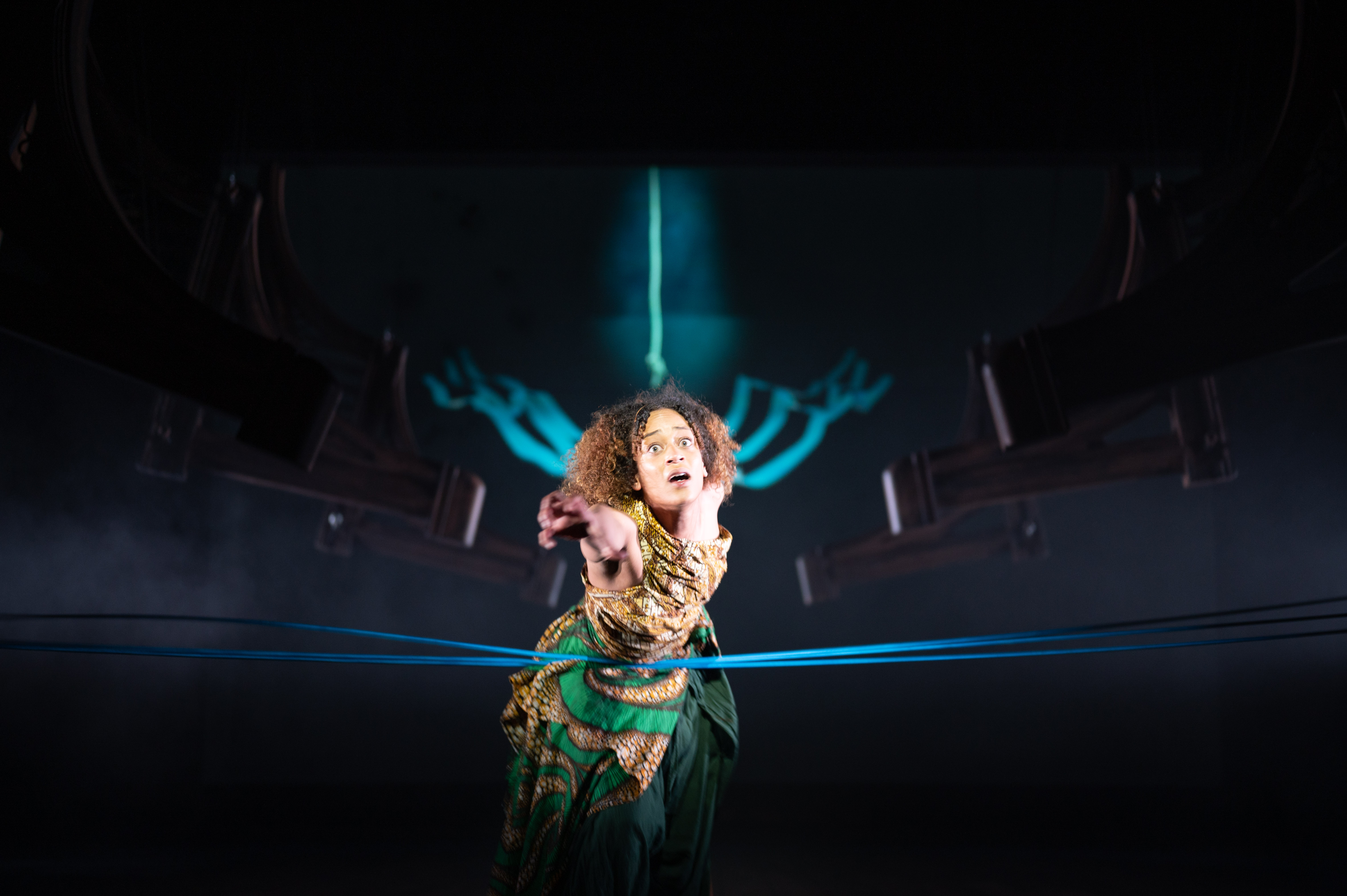
Jean Chan’s subtle “less is more” approach, especially in terms of set design is also clever as it allows the audience to use their imaginations, but there’s sparks of humour there too, especially in the bookshop.
It takes a special kind of talent to write, direct and star in your play – as Olaudah, Terera is rarely offstage and commanding of one’s attention, but the magic in that is that he does so even when he’s not speaking. Throughout the play, the character arc Olaudah goes through becomes far more intimate and personal than the wider focus, and it’s remarkable watching Giles tap into all those facets of his personality: the warmth, humour, strength, vulnerability and everything besides, because he does so with such ease.

Elsewhere, Paul Higgins cuts a striking figure as Granville Sharp, likeable even in the face of his sexism and misogyny, and Michael Elcock shines as the passionate and outspoken Ottobah Cugoano. As always in my experience with Bristol Old Vic though, the talent across those boards is immensely strong and engaging; grabbing us from the start and refusing to let go, much like the play itself: I feel incredibly privileged to have seen it as it’s taken its next step on a journey that started with a staged reading in 2018, then was adapted for radio in 2020 in light of the pandemic, and I hope it will move on to a wider life beyond Bristol!
 Wheelie Stagey