
Hamlet has always been one of my favourite plays in the entire Shakespearean canon. I’ve always been fascinated by the tensions created by the themes: life and death, action versus inaction, corruption versus innocence, reality versus illusion, revenge versus integrity, the passing of time, and value of memory. The way these are intertwined and consistently raising questions and challenging audiences’ perception has always struck a chord with me, and I always look forward to discovering new elements and ways to interpret the words and story I’ve been so familiar with.
Enter Bristol Old Vic, who, under direction from John Haidar have created a version of one of the Bard’s most oft performed and well known tragedies that is slick, gritty and captivatingly unsettling as political unrest and fractured family collide as the titular Prince of Denmark vows to find the truth about his father’s death amidst his mother’s re-marriage to his uncle Claudius.
In the programme notes, Haidarr has noted that this production takes inspiration from four different versions of the text (First Quarto of 1603, Second Quarto of 1604, First Folio of 1623, and Fourth Folio of 1685). What struck me about that approach is that it gave the entire production a sense of playfulness: he hasn’t been afraid to make cuts, additions, or place words in the mouths of other characters. There’s a sense of being kept on your toes by that approach, and the production as a whole that feels exciting, edge of one’s seat style stuff, the pace clips along neatly as this Hamlet plays out with the edge and nuance of a political thriller. There are moments, particularly in relation to the end of act one and the play’s close that drew me in because they play around with uncertainty, and memory: indeed, from the outset of the play Hamlet is watching a tv broadcast, and carries around a Dictaphone, almost as if he’s obsessed with preservation in the face of change. Therein then comes the power of this production: arguably the piece is about change: for a country, and all the major characters in some shape of form and explores how they deal with that and the impact it has on their relationships.
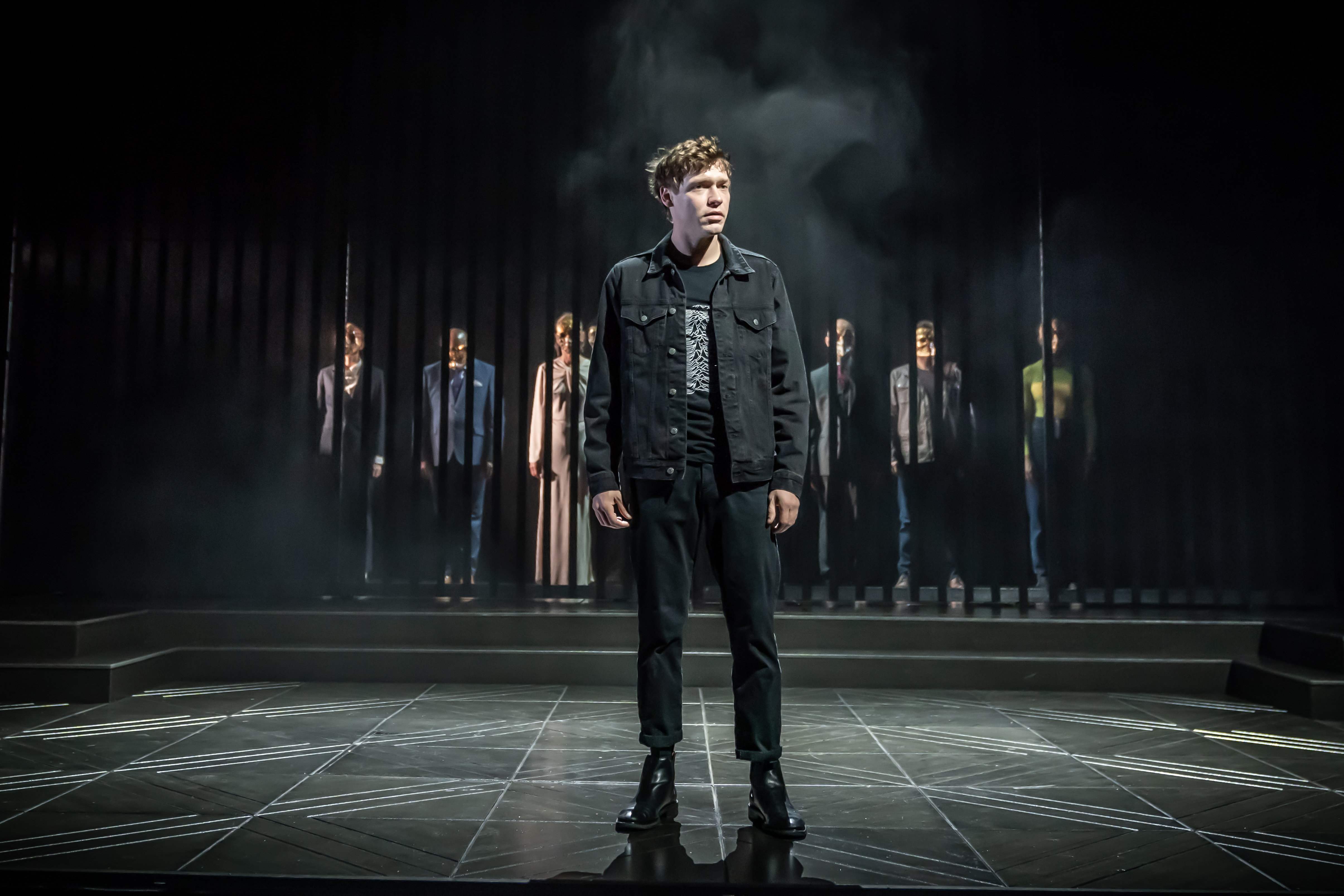
Haidar’s direction consistently finds ways to draw attention to the darkness of the piece, a mood reflected in Alex Eales’ design. We already know this is a court hiding secrets, and the set design: a raft of secret staircases, hidden doors and muted colour palettes that allow shadows to consistently play across the walls reflects that. It feels intensely claustrophobic and intimate, yet also sprawling and open, perhaps reflecting Hamlet’s turmoil and state of mind, and when coupled with the sparsely evocative lighting from Malcolm Rippeth and Max Pappenheim’s haunting soundscape and score, the tension feels deliciously palpable.

The video design from Jack Eales has moments of pure beauty that sent shivers up my spine, especially Ophelia’s hands trailing in water, but on occasions perhaps could have been punchier so as not to detract from the pace.
Billy Howle shines in the leading role, starting the piece as a more “angsty teenager” than I have been used to (a motif also played to in the costume choices), but the remarkable thing about that is the scope it gives him to grow in depth and nuance as the piece progresses. Weighed down by the prospect of taking revenge, familial loyalty and questioning everything he knows, Hamlet becomes increasingly aggressive and detached from reality, and Billy fully invests in that journey, and I did in kind. There’s a sense of frenetic energy about him, as if the world is changing and thoughts coming too fast for him to make sense of, and as a result he has to bare his soul and speak at speed, lest he won’t be heard. Yet, there’s immense power and an endearing quality to his quiet, more melancholy moments too, and I was so proud to have seen him onstage here again following A Long Day’s Journey into Night.

There’s a sense of restraint to Finbar Lynch’s Claudius that belies deep feeling, and that makes his cold, calculating edge all the more intense. He is joined by his wife Niamh Cusack as Queen Gertrude, who contrasts beautifully with warmth and presence I’ve not always found in previous iterations I’ve come across.
Elsewhere, Mirren Mack is a delightfully spirited Ophelia, and Jason Barnett is pure joy in his dual turn as Polonius and Osric, often bringing immense bursts of humour into an otherwise rather bleak and relentlessly intense piece.

I’m always grateful to rediscover plays I love with new focus and creative choices, and my beloved local theatre always rises most admirably and excitingly to the challenge.
Hamlet runs at Bristol Old Vic until November 12, including opportunities to livestream
 Wheelie Stagey