
I’ve a bit of a fractured relationship with Arthur Miller’s 1953 play The Crucible. It was one of the set texts on the curriculum for English class, and for one reason or another I found it really difficult to connect with, and didn’t truly appreciate the complexity and nuance behind it, despite actually going to see a production as part of my studies with drama class.
I then rediscovered the play at university, and inspired by the turnaround I had with a novel after a second reading, I gave the play another shot. Whether it was the fact I was just a little more mature and therefore more interested in the character’s and themes, relief at simply reading it for pleasure without the pressure of having to analyse everything and therefore more free to draw my own conclusions, or being inspired by friends at university and their enthusiasm for the piece I don’t know, but I found I connected with it much more strongly this time around in a whole multitude of ways, and in light of that I now consider it one of my favourite plays.
Happily, things also improved dramatically on the stage front where this play is concerned: I saw the Old Vic’s production in 2014 starring Richard Armitage, and thought it was absolutely stunning. Big shoes to fill then, but I’m always up for seeing new iterations, so it was over to the National for the first time in a good few years to see the latest revival directed by Olivier award winner Lyndsey Turner.
Loosely based on the Salem Witch trials and an allegory of McCarthyism (a practise whereby the US Government accused people of having links to communism), The Crucible is set in 1692 Massachusetts, where Abigail Williams and other young women are about to make themselves heard. As they accuse, fear and suspicion grows, and the tension between public and private threatens to tear a community apart.
The crown jewel for me in this production is the design by Es Devlin. From the minute you enter, there’s the incredibly atmospheric sight and sound of a curtain of rain falling, and just behind that a single table bookended by two candles and chairs set up for a sermon. I even felt like the water gave a scent to the place, which added to the effect. The rest of the design in terms of set is rather minimal (a knot of chairs here, a dining room table there, etc) and that was powerful to my mind because it gave me the chance to really focus on the words being said, and how these characters are being brought to life. When you couple minimalist design with Tim Lutkin’s delicious lighting that plays with colour, light and shadow and Caroline Shaw’s haunting compositions and sound design from Paul Arditti and Tingying Dong, the aesthetics really got under my skin and stayed with me long after the play ended.

As I touched on earlier, this is a play about tensions: public versus private, between husband and wife, tensions created by peer pressure in friendships. What struck me was how tensions also came across in some of the creative decisions. As someone who is familiar with the play traditionally hearing English accents (that’s surely ironic given that this is set in America and by an American playwright?), I found the mix of accents a bit jarring to start with, particularly Proctor’s New Jersey lilt, but I gradually settled into the rhythm with them and in Proctor’s case, felt it really added some new depth and colour to his speeches and changed how they landed.
Catherine Fay’s costumes, a mix of colours and styles: working men all in blue, Abigail and the girls in pink or floral pinafores with the odd peter pan collar thrown in, alongside a swathe of black and brown elsewhere also felt a little strange, but it struck me as an idea of giving the play a sense of timelessness: not quite fully period and yet not truly contemporary, which gave that timeless quality to the piece as a whole. That realisation was powerfully unsettling, and made me think about how the play can and still does resonate today, maybe even more powerfully in the current climate.
I came to this version of the play with pretty firm ideas about what I was going see in terms of characterisation, and I’m so grateful that this production was able to flip these on their heads, and open my mind more widely.
Erin Doherty as Abigail Williams was captivating in all her frenetic, skittish energy. I especially enjoyed how her iteration came across as a little more petulant than I had been familiar with, and through that you got a real sense of how damaged she has been by her dalliance with John Proctor, and I felt more strongly this second time around that Proctor was more at fault. That was fascinating for me, and I loved how I’m finding new layers in a play I know! Placing Abigail in that precarious position where I still found her unlikeable and yet could empathise with her more made Abigail’s malevolent, controlling streak all the more chilling; the courtroom scenes that descend into carnage as she and the other girls scream and reel off the names of those they have seen with the devil are some of this version’s most powerful moments.
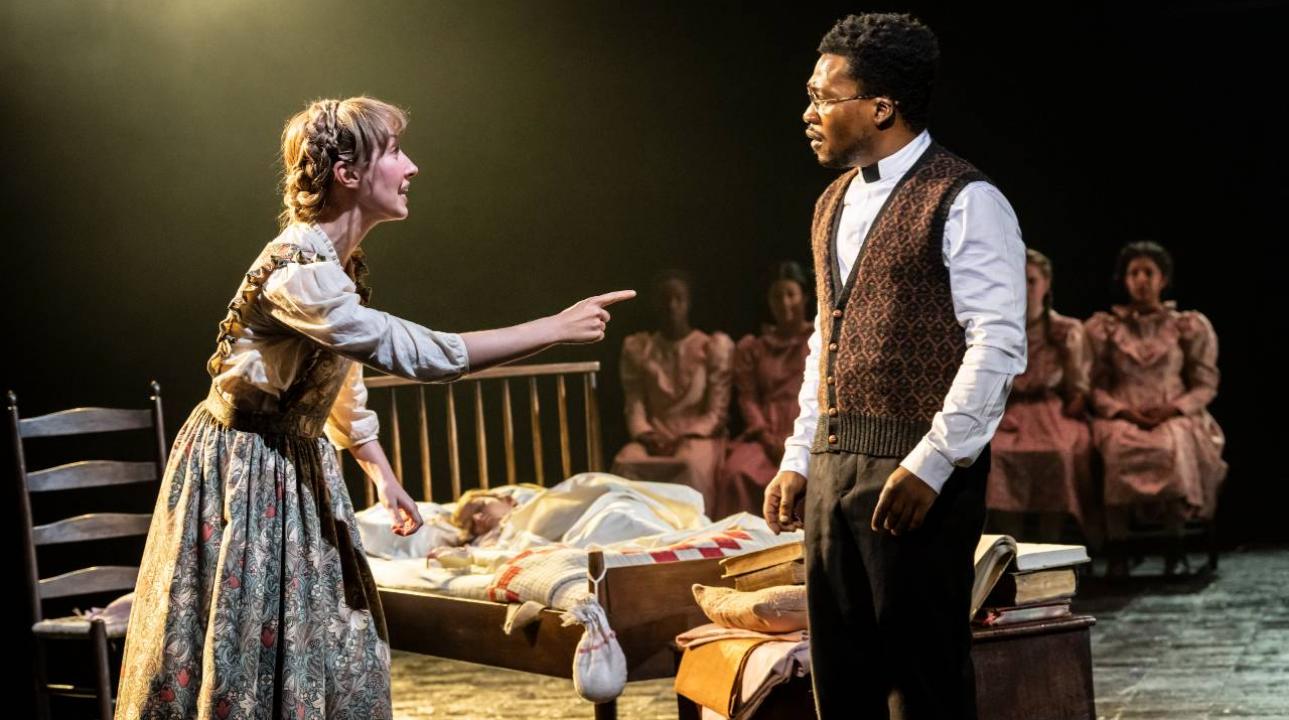
Brendan Cowell anchors the piece as John Proctor. Already challenging my preconceptions thanks to the accent and costume choices, Cowell gave the role a much more grounded, relatable quality that in turn makes his decision to cheat on his wife as disappointingly sad as it is infuriating. He brings a gorgeously understated quality to the role too, especially in terms of the moments of high emotion: so used am I to his famous “Because it is my name” speech being the point of towering, explosive anger that I was wholly, beautifully caught off guard by the quiet resignation he played with instead, and absolutely adored his “mad children are jangling the keys to the kingdom” moment that closes Act Two, and ultimately he makes Proctor far more expressive and deeply nuanced than I was anticipating.

Having only seen Fisayo Akinade in supporting roles (and those being more comedic), I was really excited to see his take on Reverend Hale, and he didn’t disappoint: watching this stoic, gentle man become increasingly disillusioned by events is always hard hitting, but Fisayo made it particularly moving, and I really felt his loss of faith given that he comes across as rather quiet, serious and unassuming, but feels deeply.
Elsewhere, Rachelle Diedericks shines as Mary Warren, the would be whistle-blower to Abigail’s tyranny, and as a longtime fan of all the work I’ve seen him do but first time in the flesh, it was a joy to see Karl Johnson on often scene stealing form as Giles Corey. The character here struck me as a more heady blend of comedy as well as tragedy and that suits Karl to a tee, he has a wonderful instinct for where to place the inflection in a word or a sentence that can completely change the weight of a scene in subtle but incredibly powerful ways!

Eileen Walsh also made an impactful turn as Elizabeth Proctor, making much more of a lasting impression than previous iterations, and with such a large cast overall it was lovely to see the more minor roles have that sense of impact alongside John and Abigail.
With a running time just shy of three hours, The Crucible is no doubt an investment and will leave you feeling drained, but Turner’s touch, Devlin’s design and strong performances all round ensure it pays off.
There’s still time to catch an NT Live Screening and though casting is still to be confirmed, the production is transferring to the West End’s Gielgud Theatre for a limited run, with public booking opening on March 9.
 Wheelie Stagey