
I’ve always said that I love this industry with all my heart and soul: it’s given me so much to be thankful and grateful for, and that will never change. Yet, as a disabled person, I struggle regularly with how often it manages to make me feel rubbish about myself: the limited seating, often with poor views, being invited to and having to decline events due to a lack of access, not being able to attend a vast majority of theatres and sit together with my other disabled friends. The biggest bugbear of all though, comes from one of the most powerful things I think art, especially theatre can offer people: representation. People being able to see themselves reflected in the stories being told, the people telling them, and the people behind the scenes ensuring the show can go on is an immensely powerful thing, and I’ve seen what a difference it can make.
The disabled community’s chances for representation in all those ways have been few and far between. All too often, when we are included, our disabilities are the lynchpins of the story, as it was in 2019, the first time I saw a disabled actress in a production; the play A Day in the Death of Joe Egg. That approach can veer dangerously into what is known as “inspiration porn” – wherein disabled people are deemed brave, inspirational and any number of adjectives just for simply living our lives the way everyone else does. Now, I don’t want to speak for the entire community, and it would be remiss of me to not acknowledge that I found Joe Egg… to be valuably cathartic, but it I find can get incredibly wearing and patronising, and I am fully aware of my sense that theatre isn’t a space where I’m going to see myself, but that absolutely doesn’t negate the fact that I find myself longing for new stories, fresh takes, changes in attitudes, and thankfully, very recently discovered there are creatives out there who feel the same.
When Henry Fraser was 17, an accident whilst on holiday in Portugal changes the trajectory of his life, and that of his family. A gifted rugby player from a family devoted to the sport, the extent of Henry’s injuries meant he was paralysed from the shoulders down and uses a wheelchair as a result, but his physical recovery defied all medical expectations. Not only are there those physical changes to adapt to, the family are all adjusting to how that major physical change shifts the family dynamic and relationships. Henry, too, discovers a new passion as an artist, adapting the tools so he is able to use his mouth to paint.
Now, that may not sound go to material for a musical, but that’s exactly what’s happened: Nick Butcher, Tom Ling and Joe White have adapted Henry’s bestselling memoir The Little Big Things into a musical. I had the chance to interview the trio for BroadwayWorldUK a few months back, which was an absolute joy and got me so excited to see the piece in its entirety; which I did, for the first time, last week.
I started this blog talking about representation, and that seems like the perfect point to pivot back to: I have never, ever felt so safe, seen and valued as a disabled person who loves this industry as much as I did watching this show, and I wish I could bottle that feeling and keep it with me always. The minute I saw Ed Larkin and Amy Trigg, the wheelchair users in this cast take to the stage, I choked up and had a really strong sense that this was going to be a complete gamechanger for me and a really special experience, and happily that didn’t leave me. Joe White’s book radiates warmth, humour and sensitivity by the bucketload, and I loved that he had the gumption to give some of the lines I found the funniest to the disabled characters, ably assisted by Nickie Miles-Wilden’s dramaturgy/associate direction, and Luke Sheppard’s direction.
Luke has a really tremendous gift for blending energy and subtlety, so often there’s scope for each scene to hit numerous emotional beats, and I think there’s a really beautiful balance throughout the piece. There are moments that I felt weren’t fully explored to their potential (especially tension between Andrew and Fran), but ultimately, the show is really assured and confident in its vision: joy.
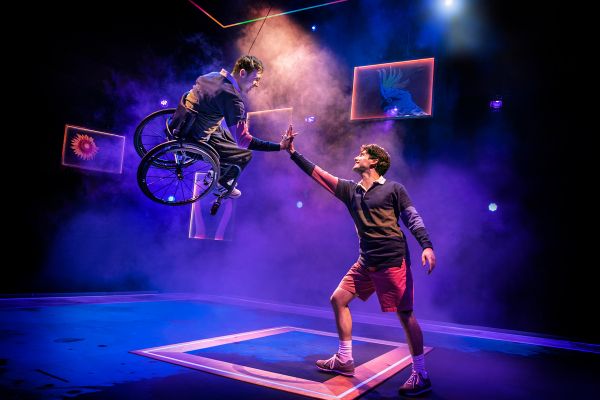
That sense carries through to the staging: Colin Richmond’s set is brought to vivid life by Luke Halls video design: colour plays a huge role in this show, and my best advice to anyone booking the show if they want to see this effect in its full glory: go for seats in the theatre’s balconies! Howard Hudson’s lighting design also adds to the power of this motif, and provides real energy and character to London’s newest theatre space. Speaking of, the space itself is really impressive (though a note to fellow wheelchair users who can’t or don’t wish to transfer out of their wheelchairs – you might find it easier to wait until the rest of the row is seated before you enter, I found having to repeatedly reverse to let people in a little annoying) , and it’s a really unique experience watching a musical in the round, there’s almost a filmic quality to it, and you’d certainly benefit from seeing it from all the varied angles and picking up on all its nuances.
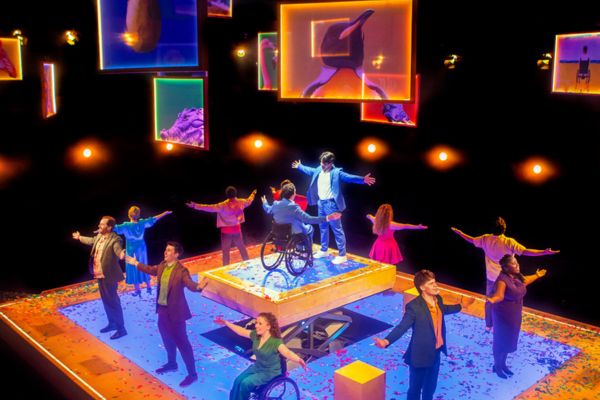
There’s some bold and beautiful work from Mark Smith in terms of choreography: I adored how BSL has been incorporated in particular, and much like the rest of this show, there’s a sense of “why has it taken this long?”
Something that Tom said when I interviewed the trio really stuck with me: he said that as songwriters, you look for those moments where characters can no longer speak, so they have to sing. Alongside Nick Butcher’s theatrical pop score, there’s a lovely mix of uptempo numbers and ballads, and what I love best is that they all serve either character or the narrative, and help move the story forward. Just on my first experience: “Guide You” has been my standout number, and the one I’ve listened to most following the visit: I just find the context of the number incredibly moving, and the orchestrations made me go all tingly. (Another note for anyone like me, has a sensitive startle reflex: this number might make you jump. 48 mins into the act, the lyrics mention the colours, red, blue and running down the page, accompanied by three loud bangs, the third being the loudest.) I was also really touched by “Miles and Miles”, the solo for Andrew, Henry’s dad. It starts off reflecting on a boat trip that the family took, but I found you hearing it in the context of the scene and its place in the story, I think it became something deeper and more meaningful, as many musical theatre songs do.
Henry is represented by two actors: Jonny Aimes and Ed Larkin. Jonny plays Henry pre his accident, and Ed after. What’s striking is the decision to keep both actors onstage together for a vast majority of the time, and they directly interact as part of Henry’s subconscious. That’s a clever technique to demonstrate Henry’s processing of the trauma, but I think it really comes into its own when it comes to humour too, especially in terms of Henry’s crush, Katie! Jonny has a really charming presence, and this shines through during the scenes with his brothers, and vocally too.
I adored Ed Larkin as Henry, he has a real understated warmth and charisma about him, but also an ease to deliver some of Joe White’s most witty deadpan humour. My favourite scenes were actually between Ed’s Henry and his dad Andrew, where after a tense moment between his parents, Henry acknowledges something his mother said in anger, and is essentially saying to his dad that he still recognises him. There’s also a moment between Henry and his youngest brother Dom (Jordan Benjamin) that stopped me in my tracks, involving something that’s never happened between them before that brought a tear to my eye!
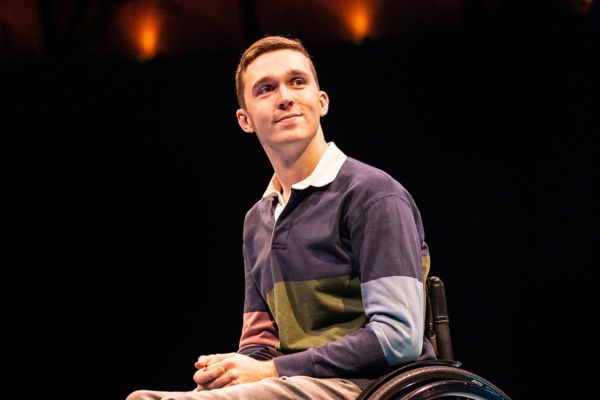
The Fraser brothers are completed by Jamie Chatterton as Tom and Cleve September as Will – I found they all had believable chemistry, and there was something sincere and relatable about their relationship, both before and after Henry’s accident. It’s been a long time since I last saw Cleve onstage, and it’s been a pleasure to see him in a bigger role where he gets to flex his comedic and dramatic muscles.
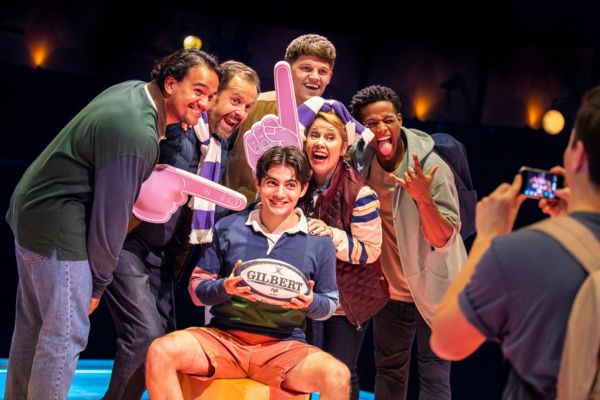
Heading the family are Linzi Hateley as Fran, and Alasdair Harvey as Andrew. This show marks the first, long overdue opportunity I have had to see Linzi work in person, and I’m so grateful for the experience: she plays Fran beautifully with a vocal to match. Though my journey with disability has been different in the sense that mine has been lifelong and not as a result of trauma, I marvelled at how easily I saw shades of my own parents in both Andrew and Fran: my mum has always been a constant source of love and my fiercest cheerleader, and that’s not to say my dad wasn’t, it’s just that he articulated his feelings differently, and wasn’t as open with his emotions. Similarly here, Fran’s emotional arc through the piece is different to her husbands. Nick and Tom have written Fran a song called “One to Seventeen” wherein she recounts every year of Henry’s life, after hearing the news of his accident. In Linzi’s hands, that number quite took my breath away, but it was brilliant to see her let loose with some more humorous moments too.
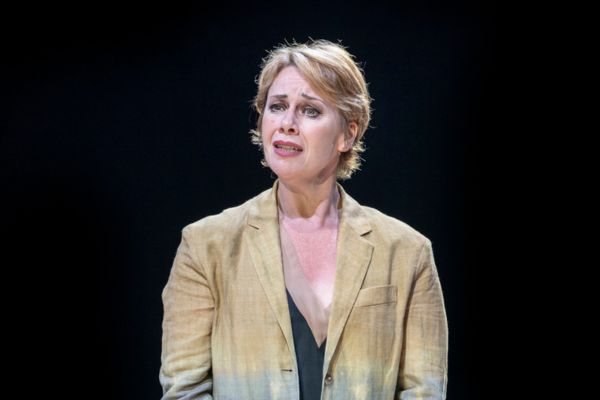
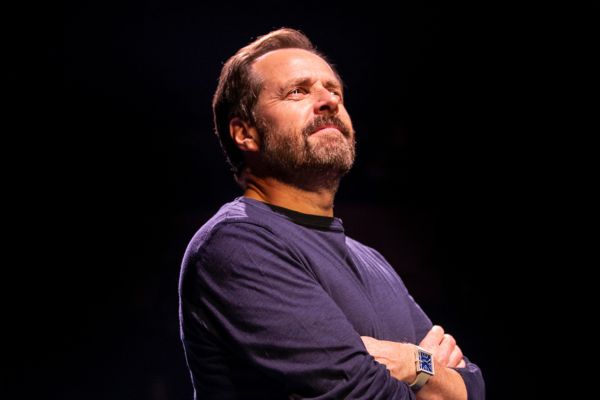
Alasdair was in my very first West End show, and I’m always going to regret not managing to see him as Nick in Come from Away, so I’m so happy that this show has brought him back into my world. There’s something so powerful and poignant about Andrew’s stoicism, and the way he throws himself into work as a way of coping. His journey comes in the sense that I think he has to re-discover what’s important, and it’s lovely to watch Alasdair play those dynamics.
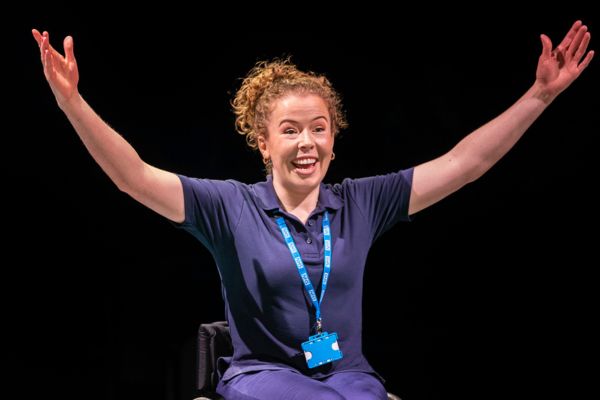
Agnes, Henry’s sassy, straight talking physiotherapist is brought to utterly joyful scene stealing life by Amy Trigg. Agnes represents everything I wish I could be more of as a disabled woman: more outspoken, more resilient and more at peace with myself. I have struggled (and at times still do) with a lot of internalised ableism, and so it was so refreshing to see a character have such confidence in herself; Joe’s writing has given Agnes some absolute comedy gems that had me belly laughing – a particular favourite involving unicorns and horses, but also some really provocative monologues that spoke so loudly to my own experiences that I was nodding every time she spoke, or resisting the urge to cheer. Amy brings such an ease to the role, and her coming timing is whip sharp, and I so look forward to seeing more of her, in this role and beyond!
Just as she did in the previous role I’ve seen her in, Malinda Parris makes a lasting impression with relatively scant stage time, and once more has vocals to die for. Gracie McGonigal’s Katie and Tom Oliver as Marco also make the most of every second the script affords them, with instantly endearing results.
What’s truly apparent to me is the sheer love every member of the team, onstage and off, has for this material: they care about it so much, and their energy and enthusiasm becomes infectious and even though it does hit close to home at times, it was really freeing to feel like I had permission to go through all the emotions, and it ended up being cathartic in ways I did expect, as well as ways I wasn’t.
Bold, bright and fizzing with life, The Little Big Things is the show I’ve been waiting for, and I hope audiences continue to embrace it with open arms. The team spoke with me about their hope that it is a beacon for change, in terms of what can & should be done, and I know what it has done for me already. That feeling doesn’t come around all that often, so while it lasts, I’m holding onto it with both hands.
 Wheelie Stagey