
Thanks to the team at Chloé Nelkin Consulting, I had the wonderful opportunity to interview Ryan Murphy, Artistic and Managing Director as well as Artist of Tit for Tat Circus, about their latest venture: Now I Am Become Deaf (Destroyer of Words) that will be performed at Norfolk and Norwich Festival, Hat Fair Festival, Just So Festival and Timber Festival, as part of Without Walls 2024.
Without Walls is one of the UK’s most highly regarded outdoor arts and performance specialists, bringing together a network of 35 organisations that bring the best of the genre to towns and cities across the UK. Since their formation in 2007, Without Walls have developed and toured over 200 shows, nationally and internationally across 22 countries.
Now I Am Become Deaf (Destroyer of Words) is a fusion of circus and physical comedy, following the journey of an unassuming clown navigating hearing loss whilst wanting to connect with his audience. An autobiographical piece, Ryan spoke to me about the idea behind the show, why touring is so vital, how the art of circus lends itself so well to storytelling, and much more besides…

Congratulations on Now I am Become Deaf (Destroyer of Words) being presented as part of Without Walls this year! How has the buildup and the creative process been for you?
Thanks! Its been really nice, the Without Walls team have been really friendly and supportive, which is great because its sort of daunting doing a solo show! I’ve led small ensemble projects in the outdoors before, but it’s the first time since circus-school really that I’ve worked on a solo piece. It’s both freeing and easy to get lost in not cementing things! But my collaborator, Maia, has been there to prod my ideas and to throw creative curveballs at the right moments – and that’s helped a ton.
I understand that the piece is autobiographical and love the premise – was this fusion of circus and physical comedy always the way you envisioned your story being told, or has the medium developed the original idea?
It is autobiographical, but it doesn’t have a linear narrative as such. I’ve actually been working recently on an indoor piece called ‘Shush’ which is much more of a linear story, working with text and captions, looking at progressive hearing loss. It explores feeling stuck between worlds – not feeling part of hearing society, nor fully part of Deaf Culture. But this piece, ‘Now I Am Become d/Deaf (Destroyer Of Words)’ is more a celebration of a character. In a sense, it is much more freeing.
Working with Clown taps into a primal and honest part of myself, and that’s very liberating. Its less bogged down in heavy logic and taps into the things that bring me joy. Physical comedy is ingrained in my heart from a lifetime of watching Chaplin, Laurel & Hardy, Keaton, etc. I fell into Physical Theatre & Circus because they are physical and visual artforms that don’t require words – but still speak in volume. Clowning is really about honesty, letting down your guard, and embracing sincerity – even when things go wrong. So in a way… there is no other way to envision it. It is an honest reflection of who and how I am, which rarely gets a chance to speak in its own way
.
Is it more nerve wracking, presenting a piece that is autobiographical?
Oh yes. Haha. But if we don’t push ourselves a little outside of our comfort zones, the work can be mundane, repetitive, boring. We stay safe, and repeat old patterns, and don’t arrive at innovation. I feel a huge part of my identity is both in the world of the hearing and the world of the deaf, yet somehow, at the same time, entirely separate to both. I don’t fit in. I can worry about how the piece could be perceived, but I have to remind myself I am not speaking for other people (well, I’m not speaking at all, but you know what I mean!). I was born with a degenerative bilateral hearing loss, as was my sister. We are much more deaf than hearing people ever seem to realise.
I am losing the ability to socialise and communicate in one world, which to be honest I actually have mixed feelings about, and I struggle to access another. But the reality is; my hearing loss has shaped me into who I am. It’s a part of me. Its influenced every action, thought, fear and desire. Its no more nerve wracking than life itself. And life, even with its hardships, carries a beauty, joy, and wonder. And, lets be honest, its more than a little ridiculous too.
How did you first get into circus, and what is about the genre that you enjoy so much and you think lends itself so well to telling stories like Now I am Become Deaf (Destroyer of Words)?
Hah. I can’t remember why, because usually I walked home anyway, but there was a time at secondary school (I think year 8 or 9?) when I was waiting for my step-dad to pick me up from school (his love for Laurel & Hardy and the Marx Brothers, along with my Mum’s as well as my Dad’s, has certainly been an influencing factor…!) and for some reason he was 2 hours delayed.
I wandered around the empty school (Ratton, Eastbourne), bored, and stumbled into the drama studio. There was a piano there. I can’t play, but I liked seeing how many of the high-pitch keys I could hear / feel the vibrations of. To my surprise when I opened the doors, the room was filled with children on unicycles, juggling, spinning poi, staves, diabolos, etc! It certainly made 2 hours fly by. And, long story short, I became a regular member.
The guy that ran it, Will Ashwell, saw me plodding away at it – and eventually he recruited me to join him in teaching circus workshops as an assistant, all around the South East. There were worse jobs! I did that during summer holidays with him, even through my college A-Levels. He and his partner, Kate Hazel (who I later re-met, as she had become Winchester Hat Fair’s Festival Director!) encouraged me to check out the UK circus schools.
I actually wanted to be a screenwriter or a photographer, but I thought I’d audition and give it a whirl. I got into Circomedia in Bristol when I was 19, I think in 2009, and it was the ideal school to be integrating theatrical ideas, comedy, and Lecoq theatre styles with Circus. The Artistic Director and physical teacher there at the time, Bim Mason, continues to be a huge influence across my work. The juggling teacher, Rod Laver, encouraged me to study further – so after Circomedia, I went for a final year at the National Centre of Circus Arts (then called Circus Space) in London.
When I graduated, my Australian juggling pal (that I met in the first year at Circomedia, Louis Lamprell) asked if I wanted to make a show. We made ‘The Most Dangerous Cup Of Tea In The World’ – and from it we made our company ‘Tit for Tat Circus’ …and that was it! The circus had me! I’m not sure if it won’t let go of me, if I won’t let go of it!
As for how circus-theatre lends itself to telling stories… I think, at its heart, circus shows the extremes of humanity. Whether that’s technical perfection, or pushing physical boundaries, or the clown embracing failure, or the effort to pick yourself up and keep trying. I particularly love bringing this to the outdoor arts – where the divide between spectator and spectacle is lessened. It isn’t lit in stage-light, far removed, on some mythical pedestal. Its right there, in your local street. And, I think, all good stories celebrate, magnify, or highlight something innately human.
Circus is so human. Despite how outlandish it may seem. That’s why it lends itself so well to theatre both indoors and out. Because its is made through struggle, sweat, effort, play, and joy. It begins in something so innately ordinary, that it can become extraordinary.
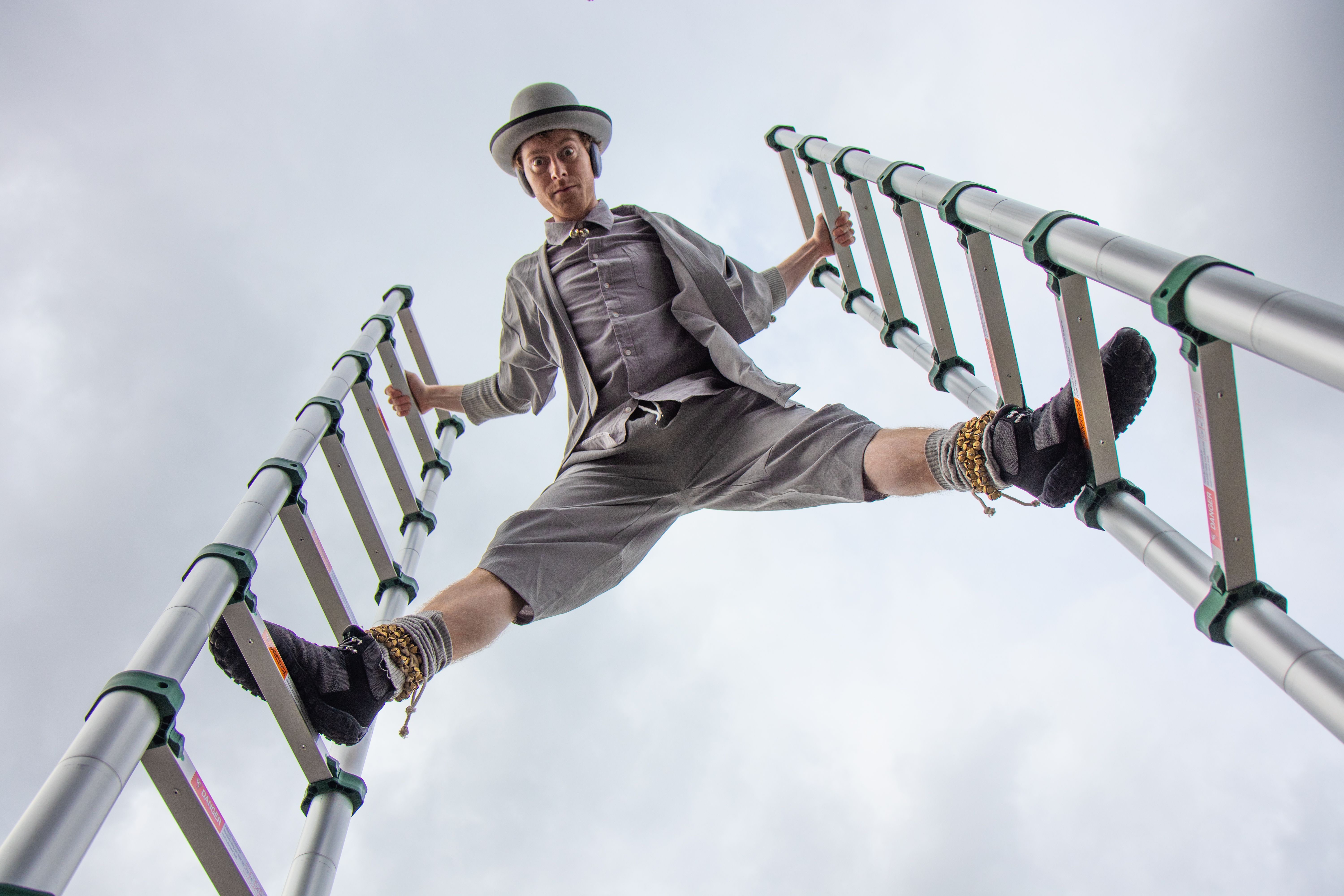
Now I am Become Deaf (Destroyer of Words) is being performed at Norfolk and Norwich Festival; Hat Fair Festival; Just So Festival and Timber Festival! Why is touring work so important for artists, creatives and audiences?
Because art is for all! There shouldn’t be barriers in accessing art and entertainment. By bringing the work directly to local streets and public spaces, it is on the doorstep of the people. Not car rides away. Not time-off-work distances away. Not expensive ticketed venues-away. It’s there, right where you are, with open invitation. It also gets artists meeting audiences and audiences meeting artists. There’s real feedback and honest response to the work, which makes future work so much more relevant. Art is an exchange. Live performance is a relationship between the performer and the audience. This is most evident at outdoor settings – it’s not just me! You’re all there too! We celebrate something together, and together it becomes something special.
What do you hope your audiences take away from coming to see the show?
Honestly, I just want them to have felt a sincere connection. For 30-40 minutes I will say “hello, this is me, am I heard? Am I seen?” And I hope that they feel heard and seen themselves. I want to connect, in a way that doesn’t need ears or words. I hope they enjoy my physical antics as a way of introducing myself, and I hope they can’t resist some wide-eyed grins.
You have degenerative hearing loss – how has that changed or developed your creative practise; I imagine it’s made you more adventurous in some ways, but you’ve had to adapt to some challenges too?
When I am alone on stage, in total silence, it is not quiet for me. I hear tinnitus. It is loud, nuanced, complicated and varied. It is the soundtrack to my life. Shifting whistles and drones, sudden invasions of bells or discordant chimes. My goodnight and my good morning. A tuneless choir in constant 24/7 recital! Annoying buggers. Very rarely they harmonise, its amazing, though fleeting. It has been there for my saddest moments, and my happiest ones. And it is always there when I create. It sits behind my ideas, follows my steps, chases juggled things and fumbled thoughts.
Embracing this, or working with it, has been a huge part of finding the sincerity in my creative motion. Its very hard to describe that relationship. I love it and hate it. But at the end of the day, it is only me.
Of course, creative practice isnt just the artistic process! It’s the daunting networking events, the acoustic ridden rehearsal rooms, the inability to connect with other inspiring artists, the inability to follow what the director said, its the difficult dinner after the show, events that maybe you choose to forgo – often disappointing others! The most important thing I have learned is to advocate for myself, to be content with what I need, and to find other ways to share and connect.
In physical theatre, it has made me a great observer. And that has certainly lent itself well to acting, imitation, clown, and character. In circus, when I am lost in the physical, it matters so little. And yes, it helps me dare to connect in eccentric ways.
And maybe leading on from the above, what advice would you give to other creatives in similar situations who might not think circus is a good fit, or something they want to explore?
If you ever tried to make a jump, or take a step, or reach for something that’s just too far – you know what circus is. Circus isn’t just doing gymnastic from the age of 6. Circus is a community, a mindset, and a personal joy. Its varied, diverse and multicultural. Its about pushing your own boundaries, growing how you want to grow, and saying “pah!” to things or people that get you down. It challenges how you think about yourself, and how you perceive the world. With circus, the world becomes a climbing frame, mundane objects become vessels of play, and rhythm and tempo begin to slow down. Instead of asking “why?”, shrug and ask “why not?”. If it’s not for you, that’s ok too. The world is full of other fascinating things.
What do you think the future of the industry looks like for circus and accessibility?
It’s a long journey, but its getting there. The arts is trying. Other sectors aren’t so much. There will be mistakes. Things will fall short. But the sector will learn. There is a lot of heart and tenacity in the arts. People care. People are talking. People are trying to improve. Change will come from the roots up. And organisations are supporting that – facilitating it, empowering it, and even making way. Its hard to say how it looks; anyone with any sort of accessibility knows it takes more than honeyed words and a can-do attitude. But the progress made in just the last few years has been huge, and voices are only getting louder and clearer. Get involved to be the change you want to see.
You can have one sentence, or three words: convince people to come see Now I am Become Deaf (Destroyer of Words)!
Teeter. Laugh. Plunge.

To find out more about Ryan, visit: https://ryanmurphycircus.com/
Follow Tit for Tat Circus on Facebook, X and Instagram
For more on Without Walls, including the 2024 programme: https://withoutwalls.uk.com/
 Wheelie Stagey