
2024 has been a bit of a milestone year for my theatregoing in that I’ve been really trying to make a concerted effort to see more new work outright, and those shows that have maybe been on my radar for a while, but I’ve never got round to them. The way that seems to be manifesting itself lately, much to my delight and surprise given my tendency towards musical theatre, is that I’ve seen more plays in the first six months of the year than I normally would. Last night, I was honoured to be back at my beloved Bristol Old Vic for Press Night of Gareth Farr’s fifth play: A Child of Science.
“One day, we will gift two honest, decent, trusting volunteers a baby. I know this more than anything else in the world. I know it in my soul. We will do that”.
In 1978, pioneering doctors Patrick Steptoe, Robert Edwards and Jean Purdy changed the medical landscape as we know it with the creation of IVF, a procedure which to this day has helped over twelve million become parents the world over.
How did they get to that momentous discovery, and deal with the criticisms faced? This is exactly what Farr’s new play explores, based on extensive research with embryologists and fertility doctors, as well as accounts from those whose lives IVF has touched, and what’s apparent from the outset is that Farr’s writing deftly balances light and shade: indeed we begin in 1958, where we witness the horrifying butchery of an illegal abortion, and begin the journey that was made possible thanks to the courage, resilience and sacrifice of over 200 women who volunteered for the trials. Of course, there’s going to be a scientific edge and data, but Farr’s strength is in the way he tempers the science with the human story: the hope, the disappointment, the frustration, that narrative grounding in the play being about the people and their experience is never lost and is all the richer for it and it’s quietly compelling, shot through with warmth and wit.
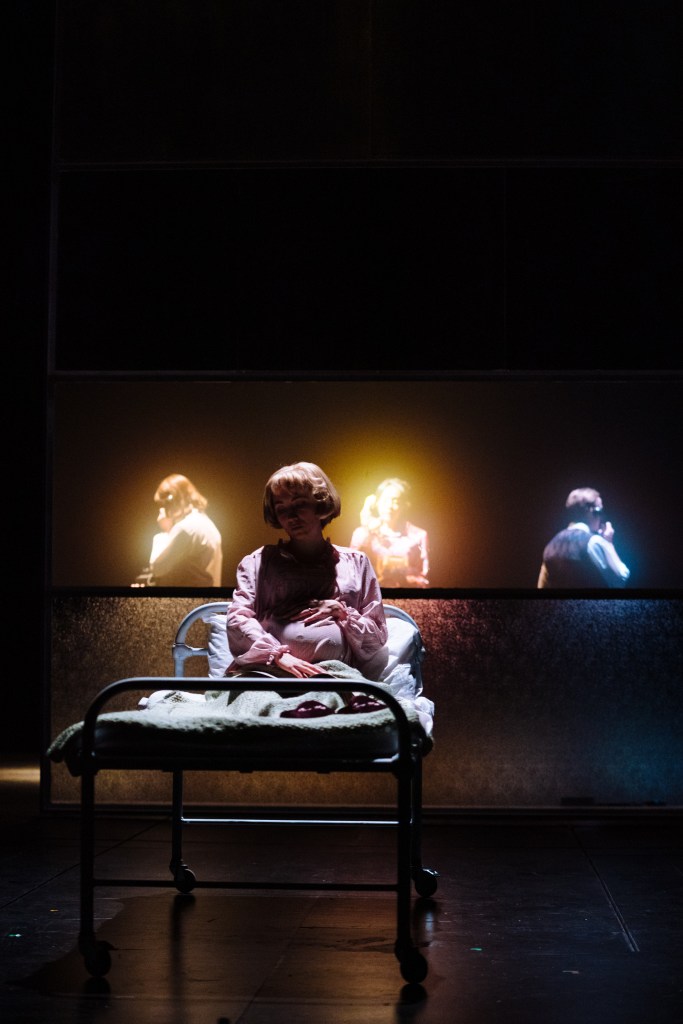
The design by Anna Fleischle (set), Niamh Gaffney (sound), Gino Ricardo Green (video) and lighting (Sally Ferguson) has moments of sheer atmospheric brilliance, the crowning glory I felt being the inclusion of a choir of women whose lives have been touched by IVF in some way: projected onto the stage at various points, singing a score composed especially for the piece by Genevieve Dawson. From my vantage point in my wheelchair, I found the lighting on one side of the stage disrupted the projections a teensy bit – I was unable to read them, and so lost the visual cue for when we were in the story chronology, and found the set having so many moving parts a little jarring as the transitions between scenes come fairly rapidly, but it’s a small disappointment when you consider that the design choices are there to enhance the story – they give proceedings a sense of urgency in keeping with the story and the arc its conveying. Matthew Dunster, whose style I’m more familiar with, having seen 2:22, shares with Gareth an exceptional skill for blending different tones and intents in the space of a scene that works well here, complementing the writing. The ending does perhaps feel a bit abrupt given the emotional investment, but arguably, the crux is the journey, and very much about that time and moment in history.
A cast of of 11, some of whom double and triple up in various guises help to tell this story: the sceptical London medical board, the press hungry for a scoop, unsuspecting husbands who have no inkling their wives have signed up for the trials and what their role in the process entails amongst others are all uniformly strong, and it was a delight to experience both extremes of emotion: belly laughing one moment to sheer, utter pin drop quiet in the next was really powerful.

Anchoring them all are Jamie Glover (Patrick Steptoe), Tom Felton ( Robert Edwards) and Meg Bellamy (Jean Purdy). Now, some of you will know that I’ve been a fan of Jamie’s for a long time, he was my original Harry Potter in Cursed Child, and so to see him onstage again after seven years was a real treat: he brings to Patrick all the warmth, sincerity and charisma that I know and love in so much of his work onstage or screen for. Tom Felton’s Bob has the relentless determination and appreciation for the work that keeps the team moving forward, and then you have Meg as Jean, balancing the two men out, her personality a mix of the two. What I especially loved were the moments where you saw the dynamics between the two men shift and change in the face of decisions made, and where Jean steps in either to reprimand or assist them as the scene calls, and to see each of the trio played with such care and nuance was so crucial for the success of this piece, and I could see and feel that in abundance. Having only Draco Malfoy as my frame of reference for Tom and Meg’s portrayal of Kate Middleton in The Crown, I took great joy in seeing them here, and I hope it won’t be the last opportunity I have to see them tread the boards!
It is Adelle Leonce’s Margaret who will stay with me long after the event, too. I believe the character is inspired by the story of many different women who volunteered for IVF. Her tenacity and spirit in the face of dwindling hope (she volunteered an astonishing 10 times in the trials before being deemed too old for the procedure to be viable anymore) was brought to life so beautifully by Adele that there was many a lump in my throat, tear in my eye, and a smile on my lips throughout the entire evening.

What was apparent at the core of A Child of Science was the sheer love everyone has for the material: both Dunster and Farr became parents thanks to IVF, and so it stands as not only as a piece of theatre celebrating a pioneering discovery, but a celebration of life and hope; and to have seen one of my local theatres have faith in a new and such an important story will never stop making me proud – I hope it has a chance at a longer or touring run in future, so more audiences can see it.
A Child of Science runs at Bristol Old Vic until July 6
Production Photography: Helen Murray
 Wheelie Stagey