
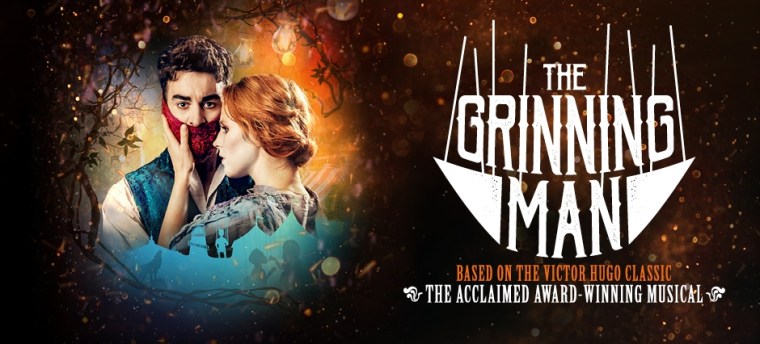
In the last two or three years of my theatregoing career, I’ve noticed that my tastes and what I look for in a piece, especially in musical theatre, has developed a lot from what it once was. I’ve become more open to new work, I love to be challenged and made to think, and find that work I enjoy most are the ones that change the way I look and feel about what’s possible in this industry; I have many musicals that I consider “favourites”, but can count on one hand those experiences that I’ve found truly transformative and so intense in terms of my reaction to them. The latest addition to this exclusive kind of affection can currently be found at Trafalgar Studios: The Grinning Man.
Based on Victor Hugo’s novel The Man Who Laughs, and originally produced at my local theatre, Bristol Old Vic last year, The Grinning Man follows Grinpayne, who is set on revenge after he was brutally disfigured as a child. He is joined by Dea, a spirited young blind woman whom he rescued from near death as a baby, both taken in by carnival vendor Ursus. Grinpayne’s quest elevates him from carnival freak at the Trafalgar Fair, into the world of nobility, where we meet the likes of Dirry Moir, Duchess Josiana, and their embittered court clown: Barkilphedro. Carl Grose’s writing has blended together a dark fairytale with clever satire. It’s dark, blackly funny and a little bit twisted, but that’s what makes it so refreshing!
Having already seen the show last year at its original home, I knew I was in for something special and unique, looking forward to seeing how it has grown and developed and translated into a different space.
This show was my first experience of the Studios, and Jon Bausor’s design immediately captures the eye and imagination: the audience is transported to the fair – walls decked with posters, ceiling with strings of multi-coloured lights, and a smiling jaw all around the stage, We move from the fair into court with atmospheric backdrops and sets, and when we pair this with Rob Casey’s lighting which can shift the mood seamlessly, the whole effect is eerie and wonderfully immersive. The show also features some of the most inventive, incredible puppetry I’ve ever witnessed, courtesy of Finn Caldwell and Toby Olié of Gyre & Gimble: Grinpayne and Dea are represented by puppets as they are growing up, and we also meet Ursus’ formidable wolf companion Mojo. I usually find it takes me a while to forget about the actors bringing the puppets to life, but found it much easier here, the quality of movement and personality they have is astounding!
You all might know by now in my circumstances with my wheelchair what having a “good” seat in the theatre means to me. Well, I seriously couldn’t ask for better here: being feet away from the actors as they perform takes the experience you have as an audience member to a whole other level in my mind, it’s intense and sometimes emotionally draining, but you never lose the connection it allows you to establish with the characters and events. Jane Gibson’s movement Direction and Lynne Page’s additional choreography really encourages the cast to fill the space both on stage and around the audience, the energy is relentless during the bigger numbers.By contrast, some of the show’s quieter moments revel in the simplicity of the staging, and that really allows you to hone in on the smaller details; eyes, expressions, body language. Tom Morris’ Direction revels in these shifts of mood and dynamics. The whole thing feels generally very playful and it doesn’t always take itself too seriously, which is a really clever move, considering it actually deals with some pretty weighty and profound themes; it feels accessible without patronising or handing the audience everything on a plate.
The music and lyrics, a joint effort from composers Tim Phillips and Marc Tietler, are by turns razor sharp with wit but also have a warmth and innocence about them when the need arises; I often find myself randomly bursting into song and it’s really gotten under my skin. The arrangements here breathed new life into songs I thought I knew, it was like hearing them for the first all over again! Some of the lyrics have changed between productions, but generally I thought for the better.
Both versions of the show have brought some incredibly talented people into my life, some familiar, but mostly new. I remember being utterly entranced by Louis Maskell as Grinpayne the first time round, but seeing and hearing him in such intimate proximity here was nothing short of earth shattering, particularly during his solo number in Act II “Labyrinth”. It’s one of my all-time favourite from the score, and I vividly remember having the most intense goosebumps and tears in my eyes. He brings warmth, strength and charisma to the character in spades, and I couldn’t take my eyes off him. The nature of Grinpayne’s disfigurement means Louis is essentially only acting with a small part of his face, which must take an incredible amount of patience and getting used to, but he does it with remarkable ease, and his ability to “speak” more with just his eyes than anything else blows my mind.
He is complimented beautifully by Sanne Den Besten as Dea, who brought a tenacity and sassiness to the character that I loved. Like Louis, Sanne has a unique challenge in that Dea is blind, and I often wondered if she found it difficult learning not to look directly at her castmates, but still having to be aware of everything else that was going on around her, and reacting to that by listening and using touch to inhabit Dea’s world. It was an interesting dynamic to watch at play whenever she was on stage, and her voice soared.
The chemistry between Louis and Sanne endeared to them both utterly and a joy to watch. Grinpayne & Dea’s relationship for me became the whole point on which the rest of the narrative came to hang; though you’ve got him seeking revenge,Grinpayne’s arc through the story is actually perhaps more about self discovery and acceptance, which he finds through the love of someone who is different, as he is. What happens with that is essentially the musical becomes more about how people treat each other, and that struck a chord for me personally in the loveliest kind of way.
Sean Kingsley once more stars as Ursus, one of the two roles thus far I have come to know and love him for. It’s always a treat hearing him sing and Ursus has a wonderful charm and vulnerability about him.
There’s also scene stealing work from the phenomenal Julian Bleach as Barkilphedro, and Julie Atherton as Queen Angelica shone in my first outing to see her in person, not knowing her for comedic type roles.
I noted at the start of this blog how I felt that my taste in musicals has changed in recent years. I want to be challenged and excited by what I see, and I got that quality in spades here: I was moved, it made me laugh and was sheer joy from start to finish. I hope to return for a few more visits, and my dearest wish is that London audiences continue to embrace and enjoy it as much as I do!


Pingback: “One Small Smile…” – Reflecting on The Grinning Man | Wheelie Stagey