
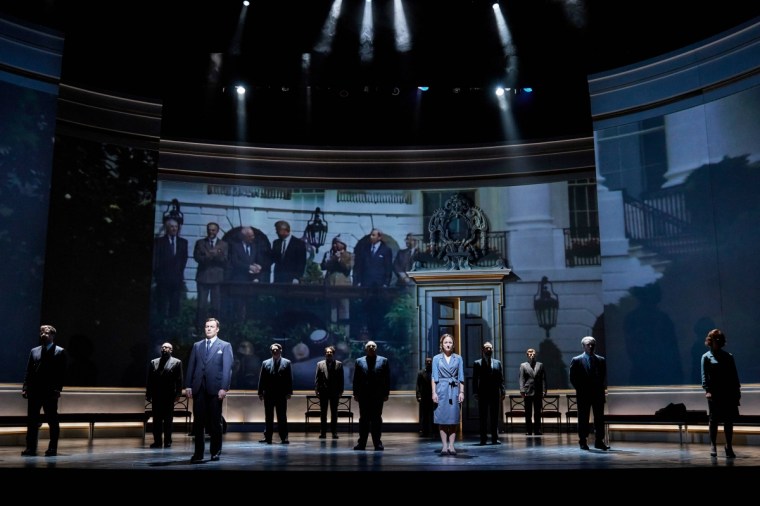
Oslo Cast (Photo Credit: Brinkhoff Mögenburg)
On 13th September 1993, the Oslo I Accord was signed in Washington DC. The document, known for short as a Declaration of Principles, set out a framework to bring about a resolution to the conflict between Israel and Palestine, in the first face to face agreement between the Israeli Government and the Palestine Liberation Organization. Being only three years old at the time, I knew next to nothing about this ground-breaking moment in history, and so I turned to my passion for theatre in order to educate myself.
In his 2016 play Oslo, American playwright J.T Rogers dramatizes the events that led up to the historic event: a series of previously secret, back channel negotiations between the pivotal figures from both sides, facilitated by Norwegian diplomats Terje Rød-Larsen, then director of the Fafo Institute, and his wife, Mona Jull, who then worked for the Norwegian Foreign Ministry.
Originally premiering off Broadway and moving to the Great White Way in April 2017, Oslo was a sweep of the 2016 – 17 awards season, winning: the Lucille Lortel Award, the Outer Critics Circle Award, and a double whammy at the 71st Tony Awards: Best Play and Best Featured Actor in a Play, to name just a few! The production ran in London at the National for a limited engagement, before transferring to the West End at the Harold Pinter.
Writing for the New York Times in June 2016, American playwright J.T Rogers remarked: “As a playwright, I look to tell stories that are that are framed against great political rupture. I am obsessed with putting characters onstage who struggle with, and against, cascading world events — and who are changed forever through that struggle”.
Having seen Oslo twice, I feel I can wholeheartedly understand and appreciate why Roger’s likes to work this way: he takes these weighty themes and complex political events, and somehow manages to make them accessible; the result is a piece that feels almost Shakespearean, a sweeping epic in terms of sheer scope, but incredibly witty, intelligent and moving. Bartlett Sher’s direction is wonderfully energetic and nuanced for the sheer level of detail he packs into the three hours, he makes every gesture meaningful, and it is in these finer details that Oslo becomes infinitely more than a play about politics and history. Muted shades dominate Michael Yeargan’s palatial set, interworked with projections of newsreel footage, reminding the audience of the historical context and keeping the tension taut throughout. You know immediately that one false move can set the entire process crumbling, but as these men bond over waffles, jokes and copious amounts of whiskey, you’re reminded that Oslo is at heart, a human drama and the play deftly works between the two.
Toby Stephens is magnetic as Terje; his unwavering belief in the process and people is infectious and what makes him so likeable but there are also flashes of wit and perfectly judged shades arrogance that give Toby the chance to really shine and make his portrayal more defined and well rounded . As a massive fan of Toby’s on screen work, it meant a great deal to me to finally be able to see him in person, I hope it won’t be my last opportunity.
Peter Polycarpou plays Ahmed Qurei, then Finance Minister for the PLO. Peter first came into my life through musical theatre, and over the years since I first saw him, has become a firm favourite of mine, a performer who I will always endeavour to do my best to see even if it means the sometime logistical nightmare that travelling presents in my circumstances. As such, knowing Peter as I have come to for a combination of his singing voice and generally more comedic roles, it was so refreshing to see him play in a more serious piece. He does a brilliant job of the transition from wary and seemingly stubborn to a more open minded, emotional figure, and every scene he gets to play between these extremes is a joy to watch as it’s done with such sensitivity and depth.
Philip Arditti brings a delightfully brazen, almost “rockstar” like quality to Uri Savir, chief negotiator for the Israeli government. His comic timing is razor sharp and he holds the power to totally change the tone of a scene or mere moment in the play on its head, for drama, comedy or some space in between with such dizzying speed and intensity that there were times I wasn’t quite sure what I was going to get… in the most engaging sense. He shares some of the plays quieter, tender moments with Peter, and the two create a bond between their characters that feels endearing and genuine – in fact we learn at the end of the play Savir, Qurei and both their daughters (named Maya) are still in touch.
Strong support too comes from Nabil Elouahabi as Hassan Asfour, and Jacob Krichefski as Yossi Beilin, but it’s fair and right to say that Oslo is an ensemble piece with equally strong performances across the board, with all fourteen cast members showcasing an incredibly tight knit and slick company; some of whom even double up into other roles!
Of course, in a play written by a man whose premise is on the most basic level getting a bunch of suit wearing, stubborn men together in a room watching them argue,women are going to stand out, and that they do, though pleased to say for the better here: Lydia Leonard shines as cool, pragmatic Mona, the antithesis to Terje’s more boundless idealism. In light of that, Mona is perhaps the lynch pin on which the action of the play drives on: Terje won’t go ahead on his plan without her ( or perhaps can’t, given her impressive Rolodex! 😉 ), men on both sides of the negotiations flirt with her and, whenever a problem rears, Mona is the one looked to for a quick thinking, smooth talking fix. Lydia brings great warmth and grace to Mona, who also acts as the play’s narrator when needed, introducing the key events and players in the accords throughout. She and Toby shared wonderful chemistry and it was always fun to watch them balance each other out. There’s also scene stealing joy from Geraldine Alexander as Terje’s & Mona’s housekeeper, purveyor of delicious waffles.
At the end of the play, Mona questions whether she and Terje did the right thing, a bittersweet moment given the fact that the Middle East (and indeed the world of late) seems as antagonistic as it once was. Terje’s final sentiment where he asks the audience to judge his tactics and the humanistic approach to diplomacy by how far we have come from where we were, not by where we are now, struck a more poignant chord with me:
“There, on the horizon. The Possibility- do you see it? Do you? GOOD!”
Just those few words summed up the power of Oslo in my mind: giving hope. I left the theatre feeling uplifted, rather than deflated as I easily could have knowing the outcome. The best pieces of theatre challenge, move and inspire in my opinion, and Oslo does each in abundance – I feel incredibly blessed to have seen it.
 Wheelie Stagey